Imagine walking through your front door at the end of a demanding day. Instead of being greeted by overflowing mail stacks, stray shoes threatening to trip you, and kitchen counters buried under appliance cords and rogue cereal boxes, you step into a tranquil, light-filled sanctuary. The surfaces are clear, the air feels open and fresh, and every object around you serves a distinct purpose or brings a genuine wave of joy. You can finally take a deep breath, kick off your shoes, and actually breathe easier in your own living space.
For millions of busy women, homeowners, and renters alike, this serene picture feels lightyears away from daily reality. Modern life has conditioned us to believe that comfort equals accumulation. Between impulse home decor hauls, well-meaning holiday gifts, overflowing toy chests, and wardrobes packed with pieces worn once three seasons ago, our physical environments have become hyper-stimulating visual noise machines. When our external environment is chaotic, our internal state naturally follows suit, generating subtle, continuous background anxiety and chronic decision fatigue.
This is where minimalist living offers a transformative lifeline. Far from the sterile, stark white art gallery aesthetics popularized by extreme lifestyle blogs, genuine minimalism is an intentional, deeply personal practice designed to help you strip away the excess so you can focus on what truly matters. In this comprehensive guide, we will break down the exact room-by-room strategies, psychological shifts, and practical organizational systems you need to build a peaceful, clutter-free home that feels lived-in, warm, and wonderfully streamlined.
What Minimalist Living Actually Looks Like (And Why It Matters Now)
To succeed with minimalist living, we must first dismantle the intimidating myth that minimalism requires you to throw out all your family heirlooms, sleep on a tatami mat, and paint every wall stark laboratory white. Authentic, practical minimalism is not about deprivation; it is about curated abundance. It is the conscious decision to surround yourself only with items that actively add utility, beauty, or genuine peace to your everyday life while lovingly letting go of the rest.
The psychological toll of physical clutter is well-documented by science. A landmark study by the Center on Everyday Lives of Families (CELF) at UCLA revealed that elevated levels of cortisol—the primary stress hormone—were directly linked to high density of household objects, particularly among mothers managing busy households. When your gaze bounces between twenty unfinished piles, your subconscious brain interprets every single item as a pending task. By embracing minimalist living, you silence that persistent sensory hum and reclaim hours of mental bandwidth each week.
As we transition through autumn and approach the busy holiday gifting and entertaining season, establishing a streamlined foundation is more critical than ever. The average American home contains over 300,000 items, and households spend an estimated $1,200 to $2,500 every year replacing items they already owned but simply could not find in messy closets. If you take the time to simplify your space now, you will navigate the upcoming winter holidays with grounded clarity, welcoming guests into a home that feels hospitable and serene rather than rushed and chaotic.
Room-by-Room Strategies for a Streamlined Home
Creating a peaceful, functional home does not require an overnight overhaul. In fact, tackling your entire house in a single weekend frequently leads to burnout and half-filled donation bags lingering in your hallway for months. Instead, apply these targeted, room-by-room systems to bring calm and visual quiet to every zone.
1. The Entryway & Living Room: Designing Visual Breathing Room
Your entryway sets the emotional tone for your entire home. When this zone becomes an unregulated dumping ground, stress begins the instant you cross the threshold. Implement a strict “landing strip” containing only three elements: a discreet wall-mounted hook rail for daily jackets, a sleek shoe bench with closed storage, and a single ceramic drop bowl for keys and sunglasses. If an item does not belong to your immediate daily departure routine, it must live in its designated room.
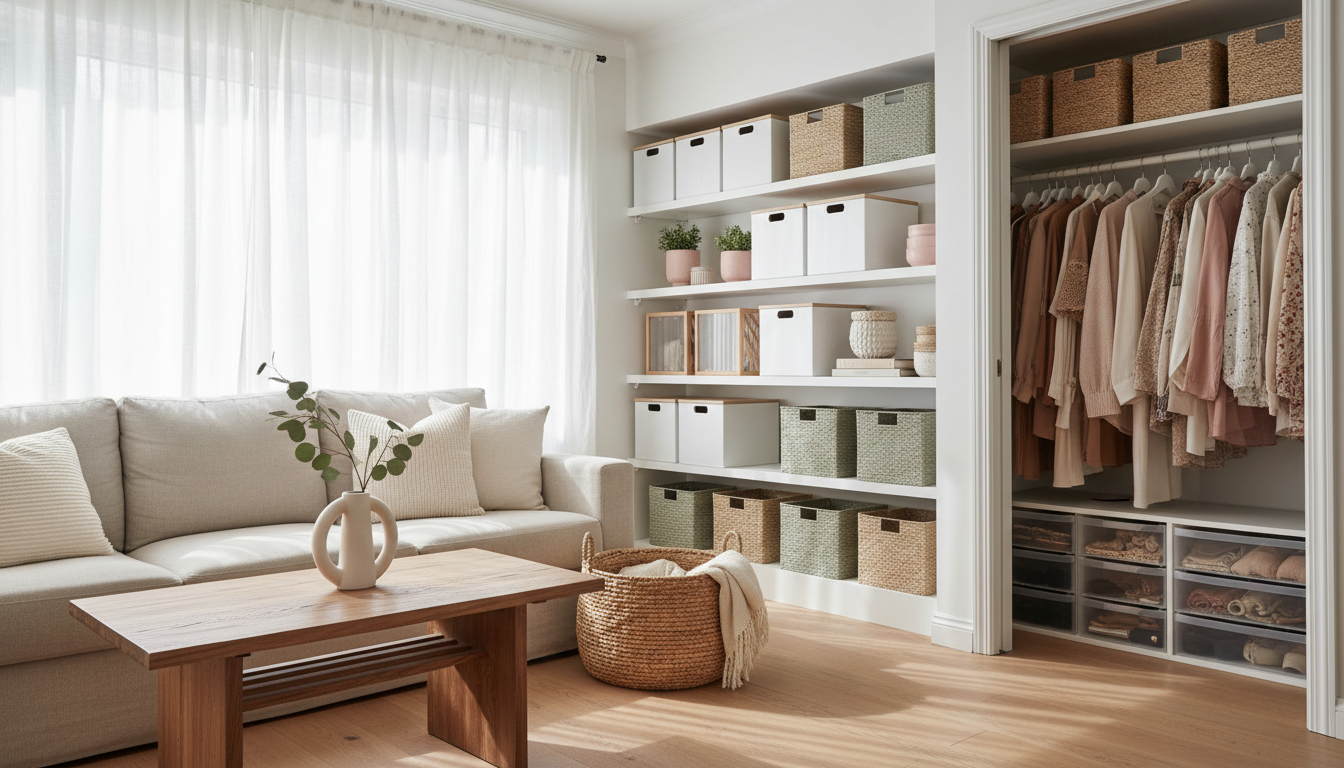
In the living room, focus on cultivating open horizontal surfaces. Clear off coffee tables and side consoles, allowing just one curated focal point, such as a textured ceramic vase with seasonal foliage or a single favorite art book. Untangle entertainment centers using cord-concealer boxes, and store cozy throw blankets in a structured woven seagrass basket tucked neatly beside the sofa. When your living room has empty breathing room, your eyes can finally rest.
2. The Kitchen & Pantry: Functional Efficiency and Clear Counters
A minimalist kitchen is not an empty kitchen; it is an optimized workshop where preparing a nourishing meal feels effortless. Begin by clearing the countertops of non-essential small appliances. If you do not use your toaster, blender, or bread maker daily, relocate them to lower cabinet pull-outs. Reserve your counter space for daily culinary prep, keeping only a handsome cutting board and an essential olive oil cruet near the stove.
In the pantry, embrace visual uniformity using clear airtight acrylic containers for dry bulk goods like oats, pasta, and grains. Combine scattered half-empty snack boxes into categorized open-front bins labeled with clean, minimalist font labels (e.g., “Breakfast,” “Baking,” “Snacks”). Install tiered bamboo shelf risers for canned goods so every label remains visible at a glance. When you can see precisely what you own, you prevent duplicate grocery purchases, saving families an estimated $150 to $300 per month on wasted food.
3. The Bedroom & Capsule Wardrobe: Cultivating a Restful Sanctuary
Your bedroom should function as a dedicated sleep and rejuvenation sanctuary, not a secondary storage unit. Remove exercise equipment, laundry drying racks, and towering stacks of unread books from beside your nightstand. Keep bedside surfaces serene, holding only a warm-toned lamp, a glass of water, and your current bedtime read.
For your closet, adopt the famous KonMari spark-joy method alongside the practical one-in-one-out rule. Pull everything out by category and ruthlessly evaluate each garment: Does it fit your current body comfortably today? Have you worn it in the last 12 months? Does it make you feel confident? If you need a comprehensive walkthrough on sorting through sentimental and practical items, check out our in-depth guide on how to declutter your home step by step. Organize remaining clothes on matching velvet slim-line hangers and utilize expandable bamboo drawer dividers to keep undergarments and sweaters impeccably separated.
4. The Bathroom & Linen Closet: Streamlining Your Morning Routine
Bathrooms frequently harbor dozens of half-used beauty serums, expired medications, and stretched hair ties. Empty your vanity and discard every expired pharmaceutical and dried-up cosmetic product. Streamline your daily morning routine by consolidating your skincare down to the essentials that genuinely serve your skin barrier.
Decant bulk hand soap and shampoo into matching amber pump dispensers to eliminate visual brand noise in the shower. In the linen closet, adopt the minimalist rule of thumb: two complete sets of high-quality sheets per bed (one on the mattress, one in the wash) and two plush bath towels per household member. Roll towels tightly using the spa-fold method to save shelf volume and instantly elevate your closet aesthetics.
4 Major Minimalist Living Myths Debunked
Before moving forward, it is essential to clear away the pervasive misunderstandings that stop people from pursuing a minimalist lifestyle:
- Myth 1: You must own fewer than 100 things or live in an empty room. Extreme numerical minimalism makes for dramatic social media videos, but it is rarely sustainable for real families. Minimalist living is not an arbitrary counting contest; it is about removing whatever feels like excess baggage in your unique season of life. If you love baking and own 15 specialty cake pans that you actively use to bring joy to your family, keep them proudly.
- Myth 2: Minimalism is expensive because you have to throw things out and buy aesthetic replacements. You do not need to buy brand-new beige matching containers from an upscale boutique to practice minimalism. The most minimalist action you can take right now is to stop buying items you do not need and thoroughly use what you already possess. Upcycling glass mason jars and cardboard shoebox organizers is just as effective and completely free.
- Myth 3: You cannot practice minimalist living with children or pets. While sharing a home with children involves toys, crafts, and gear, minimalism actually benefits children immensely. Research from the University of Toledo discovered that toddlers play longer, more creatively, and with deeper focus when presented with fewer toys (around 4 to 6 items) rather than 16 or more. Implementing simple toy rotation systems cuts cleanup time from 45 minutes down to 5 minutes.
- Myth 4: Decluttering once will permanently fix your home. Clutter is not a one-time event; it is an ongoing physical manifestation of daily habits and inflows. Practicing minimalist living requires establishing simple daily maintenance rhythms rather than expecting a single spring clean to last for a decade.
The 5-Step Action Plan to Transition to Minimalist Living
Ready to experience immediate progress today? Follow this structured 5-step framework to transition steadily toward a peaceful, streamlined home without feeling overwhelmed.
- Start Here: The 15-Minute “Single Surface” Challenge. Do not attempt to tackle the garage or the attic today. Pick one small, contained flat surface that you look at continuously—your primary kitchen island, your entryway console, or your bathroom counter. Set a timer for 15 minutes. Remove everything, wipe the surface clean with a gentle scented cleaner, and return only the bare minimum functional items. This gives you instant visual relief and proves you can master minimalist living in micro-doses.
- Adopt the Swedish Death Cleaning Mindset for Storage Areas. Inspired by Margareta Magnusson’s philosophy, evaluate your secondary storage areas (basements, closets, holiday bins) by asking: “Will anyone truly value or need this item when I am gone, or am I just storing an obligation?” If an item is being kept solely out of misplaced guilt, grant yourself permission to release it to someone who will use it today.
- Enforce the 24-Hour Cooling Off and One-In-One-Out Rules. Place a friction barrier between your wallet and potential impulse purchases. When shopping online or browsing home goods, mandate a strict 24-hour waiting period before checking out. When you do bring a new item home—such as a cozy winter sweater or a new mug—commit to donating or discarding a corresponding older item to maintain static volume.
- Build a 10-Minute Nightly Reset Habit. Before winding down for sleep, spend 10 minutes returning rooms to their baseline state. Load the dishwasher, return stray throw pillows to the couch, and clear the kitchen sink. Waking up to clear counters completely changes your morning nervous system and sets a peaceful tone for your entire day.
- Set Gentle Holiday Inflow Boundaries. As the seasonal gift rush draws near, communicate proactively with friends and extended family. Request experience-based gifts (museum passes, cooking classes, dinner dates, zoo memberships) or consumable treats (artisanal olive oils, fine coffee, luxury candles) rather than physical toys and decorative trinkets that will clutter shelves by January.
Essential Tools and Product Recommendations for a Minimalist Home
While minimalism encourages buying less, utilizing a few well-designed, functional organizational tools can help maintain structure and preserve that clean visual aesthetic for years to come. Here are the top editor-tested essentials:
- Expandable Bamboo Drawer Dividers ($25 – $35 for a pack of 4): These spring-loaded wooden dividers instantly turn chaotic dresser and kitchen utensil drawers into custom-fitted, boutique-style compartments that keep folded clothing standing vertically.
- Open-Front Stackable Wire or Woven Baskets ($12 – $20 each): Perfect for pantries, linen closets, and laundry rooms. They provide tactile warmth and texture while keeping categorized items upright and easily accessible.
- Minimalist Thermal or Embossed Label Maker ($25 – $40): Clear labeling ensures every household member knows exactly where items belong, removing the friction from putting things away properly.
- Tiered Bamboo Shelf Risers ($15 – $22): Maximize vertical space in kitchen cabinets and spice racks, ensuring no jar or can gets lost behind larger items.
- Clear Drop-Front Shoe Boxes ($30 for a 6-pack): Keep entry closets or wardrobe shelves uniform, dust-free, and visible without cardboard box visual clutter.
Step Into Your Calm, Clutter-Free Life Today
Embracing minimalist living is not about achieving cold perfection; it is about fiercely protecting your peace, your time, and your energy. Every item you choose to let go of is a physical task you no longer have to clean, dust, reorganize, or stress over. By reducing physical clutter in your home, you create spaciousness for richer conversations, deeper rest, and genuine moments of joy with the people you love most.
Do not wait for the perfect weekend or an open calendar to begin. Start right now with your 15-minute challenge on a single tabletop. Choose one surface, clear away the unnecessary noise, and celebrate the clean, peaceful space you have created. Your future, calmer self will thank you for taking that first simple step today.